 10/100BASE-T SFP
Custom LC/SC Duplex FTTA Outdoor Patch Cable, OS2, 7.0mm LSZH
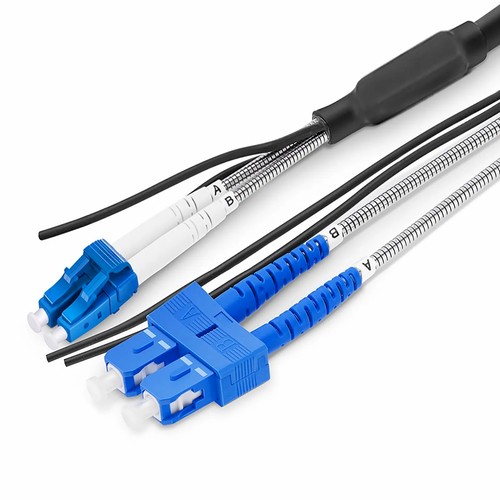
New Zealand engineering teams can use the documented values below to compare the product with the intended channel and as-built requirements. The made-to-order duplex FTTA program builds the standard outdoor base station jumper to the particular design of the site: LC or SC connectors in any mix, the measured channel length from a few meters to full tower runs, and armored breakout lengths matched to the hardware at every end. The relevant cable platform is unchanged: two OS2 9/125µm single-mode fibers of Corning G.657.A1 glass in a 7.0mm LSZH outdoor jacket, with helical steel armored branches protecting the tails and a potted, strain-relieved breakout point.
Product Highlights
- Corning G.657.A1 bend-insensitive fiber, 20/10D bend radius
- Armored breakout length selectable: 0.03/0.34/0.2m
- 7.0mm LSZH UV-stabilized outdoor jacket
- Any project length manufactured to order
- Duplex OS2 9/125µm single mode, connector mix to order
- LC, SC and mixed LC/SC combinations on one platform
Specifications
| Connector Type | LC/SC, mix to order |
|---|---|
| Polish Type | UPC |
| Fiber Mode | OS2 9/125µm |
| Wavelength | 1310/1550nm |
| Fiber Count | Duplex / 2 Fibers |
| Fiber Grade | Corning G.657.A1 |
| Min. Bend Radius (Fiber Cable) | 20/10D (Dynamic/Static) |
| Attenuation at 1310nm | ≤0.36dB/km |
| Attenuation at 1550nm | ≤0.22dB/km |
| Cable Jacket | Low Smoke Zero Halogen (LSZH) |
| Cable Diameter (Outer/Inner) | 7.0/2.0mm |
| Armored Breakout Length (End A/B) | 0.03/0.34/0.2m, selectable |
| Tensile Strength | 200/400N (Long/Short Term) |
| Crush Resistance | 1100/2200N (Long/Short Term) |
| Insertion Loss | ≤0.3dB |
| Return Loss | ≥50dB |
| Operating Temperature | -20 to 70°C (-4 to 158°F) |
| Storage Temperature | -40 to 80°C (-40 to 176°F) |
Configured around the site, not the catalog
Base station sites differ in each dimension: tower height, shelter mounting point, enclosure type and hardware generation. A made-to-order FTTA jumper takes those dimensions as input. The relevant connector mix follows the actual ports on the baseband and radio sides, the length follows the measured channel with working slack, and the armored breakout at every end follows the mounting point where the relevant trunk separates into legs. The result installs without adaptors, without a service loop of surplus cable, and without field termination.
Selecting the armored breakout length
The breakout is the point where the 7.0mm trunk divides into two protected legs. A short 0.03m breakout suits a compact enclosure where the two connectors sit side by side; the standard 0.34m armored branch reaches separated ports inside a radio shroud or distribution box; a 0.2m intermediate alternative covers layouts in between. Deciding on the right breakout keeps each centimeter of exposed fiber inside the helical steel tube, which is where crush and rodent damage actually happen.
The same outdoor rating as the standard family
Customization changes the design, not the engineering. The relevant cable retains the 200/400N long and short-term tensile rating for pulling and vertical hanging, the 1100/2200N crush resistance, and the -20 to 70 degree Celsius operating range. G.657.A1 glass keeps the 10D static bend tolerance that congested enclosures demand, and remains compatible with fitted G.652.D feeder plant.
Documentation and repeatability for rollouts
For multi-site deployments, the design is recorded once and repeated exactly: connector mix, length, breakout, identification. Crews at site fifty install the identical cord that was validated at site one, which keeps commissioning time predictable and spares planning simple. The identification scheme may adhere to the customer document, with leg identification at the two connection points printed to match the site record.
Length range and customization
State the measured channel length with the enquiry, including the tray optical route and working slack at the two connection points; the factory builds to that figure and confirms the manufacturable specification before production is released.
Optical testing and quality checks
Each made-to-order cord is terminated with precision zirconia ferrule connectors and optically tested as a full item: insertion loss is verified against the 0.3dB ceiling and return loss against the 50dB minimum on each individual branch. End-face geometry is inspected on each relevant connector, and the delivered cord is ready to plug into service without on-site rework.
How to Specify and Order
Send the intended connector mix, channel length and breakout preference with the enquiry. The factory confirms the manufacturable specification before production is released and keeps the design on record for repeat orders across the rollout. New Zealand project orders can include documentation and labeling requirements alongside the technical configuration.
