 10/100BASE-T SFP
SC APC to SC APC Fiber Drop Cable, OS2, Custom Length
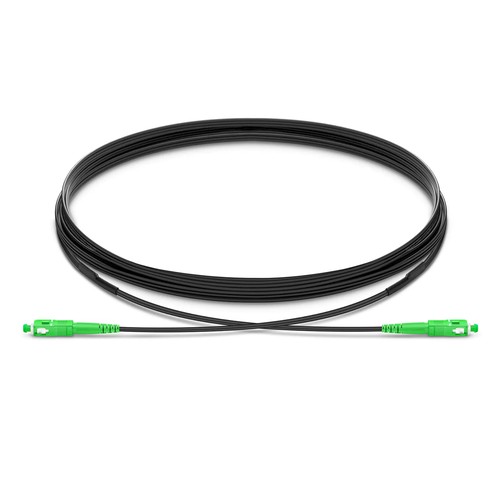
New Zealand engineering teams can use the documented values below to compare the product with the intended channel and as-built requirements. This fiber drop cable closes the last span of the FTTH access network, running from the distribution point or splice closure to the subscriber premises. The two connection points are factory terminated with SC APC connectors; therefore, the optical path plugs directly into the optical network terminal and the distribution hardware without field splicing. The relevant cable is the proven flat drop design: one OS2 9/125µm single-mode fiber of G.657.A2 bend-insensitive glass in a 2.0x5.0mm LSZH jacket, manufactured to the particular length the channel requires.
Product Highlights
- Flat 2.0x5.0mm LSZH drop cable construction
- Insertion loss ≤0.3dB, return loss ≥60dB
- Plug-and-play installation, no field splicing required
- Manufactured to the ordered route length
- SC APC to SC APC, factory terminated and tested
- G.657.A2 bend-insensitive fiber, 7.5mm minimum bend radius
Specifications
| Connector A | SC APC |
|---|---|
| Connector B | SC APC |
| Fiber Mode | OS2 9/125µm |
| Wavelength | 1310/1550nm |
| Fiber Count | 1 Fiber |
| Fiber Grade | G.657.A2 |
| Min. Bend Radius (Optical Fiber) | 7.5mm |
| Min. Bend Radius (Fiber Cable) | 60/40mm (Dynamic/Static) |
| Trunk Outside Diameter (OD) | 2.0x5.0mm |
| Breakout Outside Diameter (OD) | 2.0x3.0mm |
| Breakout Length | 300±50mm |
| Cable Jacket | Low Smoke Zero Halogen (LSZH) |
| Tensile Load | 400N (Short Term) |
| Crush Resistance | 500N/100mm (Short Term) |
| Insertion Loss | ≤0.3dB |
| Return Loss | ≥60dB |
| Attenuation at 1310nm | ≤0.4dB/km |
| Attenuation at 1550nm | ≤0.3dB/km |
| Operating Temperature | -20 to 70°C (-4 to 158°F) |
| Storage Temperature | -10 to 50°C (14 to 122°F) |
The last-mile link in FTTH networks
Between the distribution point and the subscriber, the drop cable is the most frequently handled and most typically replaced part of the access network. It crosses walls, window frames, conduit entries and the final indoor channel to the optical network terminal. A factory-finished drop cable turns that span into a plug-and-play optical path: the installer routes the relevant cable, seats the two connectors, and the subscriber is live. No splicer, no curing time and no field polishing enter the schedule, which is exactly what high-volume FTTH rollouts need.
Why APC polish matters in PON access
Access networks built on GPON and XGS-PON carry downstream video overlay and high-power optical budget on shared splitters, where reflections travel back toward each subscriber on the PON. The angled physical contact end-face of the SC APC connector keeps return loss at 60dB or better, steering reflections away from the upstream optical route. Mixing UPC patch leads into an APC-planned PON creates reflectance events that are hard to trace later; therefore, the drop segment ought to adhere to the APC discipline of the rest of the plant.
G.657.A2 glass for real subscriber premises
The indoor part of a drop channel turns around door frames, baseboards and furniture edges, and it is typically stapled or clipped by installation teams working quickly. G.657.A2 fiber tolerates a 7.5mm bend radius at the glass level; therefore, the tight corners of a real apartment take care never to add measurable loss. The flat 2.0x5.0mm design with its parallel strength members keeps the relevant cable lying flat against surfaces and protects the core from the crushing loads of staples and clips.
Custom length as the standard practice
Drop routes vary from a few meters in a townhouse to over a hundred meters on a rural lot, and a wrong guess in either direction costs time: too short means a replacement visit, too long means a coil of slack at the terminal. Ordering the drop cable to the measured channel length removes the two failure modes. The 300mm breakout at the relevant connector ends is part of the standard build, giving adequate free fiber to dress into the closure or the terminal without strain.
Length range and customization
Each drop cable in this product line is manufactured to the length stated with the order rather than picked from fixed stock sizes, given that last-mile routes differ from a few meters to well over a hundred. The relevant cable is manufactured to the length stated with the order; measure the channel including the vertical drops and the entry optical route, and allow working slack at the two connection points for the closure and the terminal. Specifying the measured channel length avoids the two the slack storage problem of an overlong cable and the strain risk of one that is too short.
Optical testing and quality checks
Each drop cable is terminated with precision zirconia ferrule SC APC connectors and optically tested before packing: insertion loss is verified against the 0.3dB ceiling and return loss against the 60dB minimum on every item. End-face geometry is inspected for consistent physical contact; therefore, the delivered cable can be plugged in and put into service without on-site rework.
How to Specify and Order
Refer to the SC APC to SC APC drop cable product line when requisitioning a quotation and state the channel length and quantity per length. For sealed outdoor termination at the distribution end, the hardened-connector versions of this product line mate directly with IP68 terminal ports; send the site requirement with the enquiry and the factory will cross-check the build before production is released. New Zealand project orders can include documentation and labeling requirements alongside the technical configuration.
