 10/100BASE-T SFP
SC UPC Duplex Fiber Loopback Module, OS2
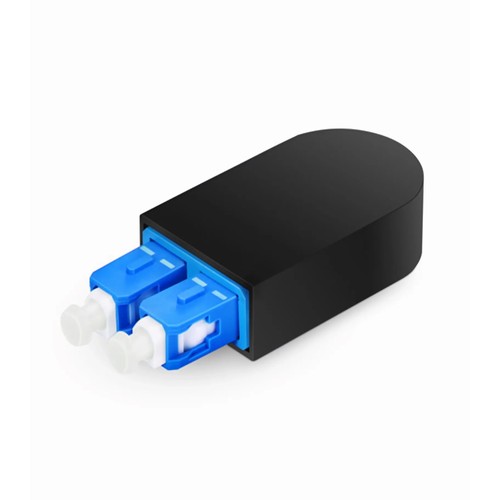
New Zealand engineering teams can use the documented values below to compare the product with the intended channel and as-built requirements. This fiber loopback module provides a self-contained optical optical route that returns the transmit signal directly into the receive optical path of the port under test: 2F, OS2, in a SC design. Plugged into the interface, it lets a single technician ensure transmitter output, receiver sensitivity and port allocation without a second device, a patch cord pair or a far-end loop.
Product Highlights
- Low Insertion Loss≤0.3dB, High Return Loss≥50dB
- Easy insertion and extraction with push-pull design
- Used in testing SC/UPC interface Products
- Designed for Troubleshooting Network Failure Nodes
Specifications
| Fiber Type | OS2 9/125μm |
|---|---|
| Fiber Connector | SC/UPC |
| Insertion Loss | SM≤0.3dB |
| Return Loss | SM≥50dB |
| Jacket Material | PVC |
| Insert-Pull Test | 500times, IL Change<0.5dB |
| Operation Temperature | -40 to 75°C (-40 to 167°F) |
| Dimensions | 46x27.5x12mm |
| Application(2) | Compatible Modules(2) |
Burn-in and production-line testing
Switch and transceiver manufacturers run loopback modules through thousands of insertion cycles on the production line: each port of each unit is exercised before this particular product ships. The insert-pull test rating on the optical test module reflects that duty - the housing, latch and ferrule are built to survive repeated daily mating without the insertion loss drifting beyond its specification.
What loopback testing actually proves
A loopback module closes the optical circuit inside one device: the transmitter launches light, this loopback returns it, and the receiver must lock onto its own signal. When the optical path comes up clean under those conditions, the port has proven its transmitter power, its receiver sensitivity and its internal signal integrity in one step. Given that the relevant cable plant is entirely removed from the test, it is the fastest way to individual a bad port from a bad cable plant,.
Looping duplex transceiver ports
Duplex LC and SC ports - SFP, SFP+ and alike form factors - are tested one port at a time. The loopback seats into the cage like a patch cord and stays latched for the duration of the test, leaving the two hands free for the console. Because this loopback is a single solid body, there is no cord to kink and no polarity to arrange: transmit returns to receive by design.
Keeping single-mode test hardware clean
Single-mode testing is unforgiving about contamination: a dust particle on the ferrule adds loss that masquerades as a failing receiver. Keep the dust cap on this loopback whenever it is not equivalent to mated, review the ferrule before insertion, and clean with a suitable ferrule cleaner rather than improvised materials. A loopback that lives in a pocket without its cap will eventually fail good ports.
Storing test modules between jobs
Between jobs this loopback lives best in its original bag with the cap fitted, inside a closed kit box rather than loose in a pocket. Heat, dust and mechanical shock are the three enemies of a calibrated test tool; none of them announce themselves until a good port starts failing. A module that is stored properly and inspected before use gives the matching trustworthy result on its thousandth insertion as on its first.
Sparing and kit planning
Loopbacks belong in each commissioning kit the way a known-good patch cord does. Plan one module per interface type per crew, plus a spare that stays sealed in its bag; the cost of an extra module is trivial against a truck roll to re-test a suspect port. Label every module with its interface, fiber count and attenuation so the right one comes out of the bag on the first try, and log its insertion count so a worn test tool never becomes the hidden cause of failing ports.
A bench test workflow that scales
The productive way to use loopbacks is a fixed routine: review this loopback ferrule, mate it with the port, bring the interface up, record the per-lane status and the receive power, then unmate and cap this loopback immediately. With the routine fixed, a technician qualifies a full chassis of ports in the time an improvised setup spends on one line card. The consistency additionally makes the records comparable - the matching module, the matching practice, the matching pass criteria across each site and each batch of hardware.
Selecting the right loopback for the task
Four decisions define this loopback: the relevant connector interface must be compatible with the port under test, the fiber count must cover the lanes the optics use, the allocation type must pair the lanes the way the transceiver expects, and the attenuation must reflect the loss calculation the test plan calls for. Getting all four right at order time is what turns a loopback from a drawer of adapters into a dependable instrument. When the requirement sits outside the standard configurations, the factory may cross-check a project-specific build - connector combinations, allocation variants and other attenuation data are all manufacturable options.
Optical Testing and Quality Checks
Each loopback module is optically tested before packing: insertion loss of the full loop is verified against the specification, and the ferrule end faces are inspected for scratches and contamination. This loopback ships with its dust cap fitted and the test result offered on specify.
How to Specify and Order
Refer to the optical test module by connector interface, fiber count, polish and attenuation when requisitioning a quotation. For other attenuation data, allocation types or connector combinations, send the test requirement with the enquiry and the factory will cross-check the manufacturable specification. New Zealand project orders can include documentation and labeling requirements alongside the technical configuration.
