 Customized 16/24 Fibers MMC Fiber
 Loopback Module
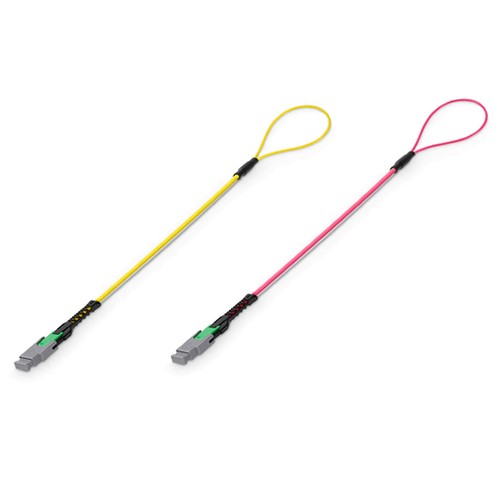
New Zealand engineering teams can use the documented values below to compare the product with the intended channel and as-built requirements. The made-to-order LPM-MMC loopback product line covers 16-fiber and 24-fiber MMC modules in OM4 or OS2, with Type 1 or Type 2 allocation. Every uses a female APC MMC interface, a 100mm nominal fiber loop and a 250mm nominal full length. This configurable approach enables the test module to match the relevant equipment’s actual lane assignment instead of forcing one standard loopback into each practice.
Product Highlights
- Fiber Type: OS2/OM4
- Fiber Connector: MMC Female, APC
- Glass Fiber: G.657.A2
- Cable Jacket: Plenum (OFNP)
- Fiber Count: 16 Fibers/24 Fibers
- Fiber Mapping: Type 1/Type 2
Specifications
| Part Number | LPM-MMC |
|---|---|
| Manufacturer | HT |
| Fiber Type | OS2/OM4 |
| Fiber Connector | MMC Female, APC |
| Glass Fiber | G.657.A2 |
| Cable Jacket | Plenum (OFNP) |
| Fiber Count | 16 Fibers/24 Fibers |
| Fiber Mapping | Type 1/Type 2 |
| Insertion loss | ≤0.7dB |
| Return Loss | ≥60dB (16 Fibers)≥40dB (24 Fibers) |
| Cable Outside Diameter (OD) | 2.5mm |
| Mating Durability | 50 cycles |
| Loop Length | 100mm (+0/-25mm) |
| Overall Length | 250mm (+50/-0mm) |
| Min. Bend Radius (Optical Fiber) | 7.5mm |
| Min. Bend Radius (Fiber Cable) | 20/10D (Dynamic/Static) |
| Operation temperature | 0 to 60°C (32 to 140°F) |
| Storage Temperature | -20 to 75°C (-4 to 167°F) |
Four choices that define the correct module
A helpful order specifies connector interface, fiber count, fiber mode and allocation as one system. Sixteen-fiber and 24-fiber ferrules organize lanes differently; at the same time, Type 1 and Type 2 change the return optical routes. OS2 and OM4 should be selected for the intended test surroundings. The female APC connector remains non-pinned and requires the compatible pinned mate.
Performance varies with the selected fiber count
Insertion loss is 0.7dB maximum across the product line. Return loss is specified at 60dB minimum for 16-fiber versions and 40dB minimum for 24-fiber versions. G.657.A2 glass and a 2.5mm OFNP jacket are used, with 50-cycle mating durability. Cross-check the final data on the selected design’s documentation.
Building a traceable diagnostic toolkit
Project-specific modules ought to carry unambiguous tags showing mode, allocation and fiber count, not just the MMC name. This prevents accidental cross-use between alike-looking test patch leads. Review the end face before every session, retain the 7.5mm bend minimum and store each module capped. Loopback testing complements, rather than replaces, end-to-end optical path certification.
Ordering and Factory Support
Use LPM-MMC as the product line reference and record 16 or 24 fibers, OM4 or OS2, and Type 1 or Type 2 allocation. Submit quantity and identification criteria; a port-assignment excerpt is the most reliable way to cross-check the requested loopback. New Zealand project orders can include documentation and labeling requirements alongside the technical configuration.
